 Kaminofinance
 liquidity vaults - choosing between price ranges
Updated
Kaminofinance liquidity vaults concentrate deposits within managed price ranges on Solana, so range choice balances fee concentration against rebalancing costs and changing token exposure. Narrower ranges concentrate capital more tightly near the market price; wider ranges provide more room for price movement before a rebalance.
A narrower liquidity range can concentrate fee income, while more frequent rebalancing can increase the conversion costs that the position carries.
Tighter ranges, wider ranges, and alternatives to liquidity provision
A tighter managed range concentrates liquidity more heavily near the current price; a wider range leaves more room for price movement.
Overall performance also reflects trading activity and conversion costs. Managed strategies automate the range adjustments that a direct liquidity provider would handle. The vault manager chooses and adjusts these ranges using volatility and fee data. Full-range pools and holding the underlying tokens provide different baselines for assessing that trade-off.
| Position choice | Range and fee behavior | Underlying token exposure |
|---|---|---|
| Tighter managed range | Higher in-range efficiency; smaller moves can trigger rebalancing. | Pool pair; one asset outside its range. |
| Wider managed range | Lower in-range efficiency; more room before boundary crossings. | Pool pair; one asset outside its range. |
| Manually managed concentrated range | The liquidity provider chooses and adjusts the range. | A position outside its range holds one pool asset. |
| Full-range automated market maker | Capital spans the price curve without selected range boundaries. | Pair proportions change as swaps execute. |
| Holding the underlying tokens | No liquidity-pool fees or range adjustments. | Holding introduces no pool-driven token conversions. |
When two available strategies use the same pool pair and fee tier, compare their bounds against the current market price. Following the tighter range can require a rebalance on a move that leaves the wider range active. Staying with the wider range avoids that particular adjustment. Repeat the boundary comparison after prices change. The reopened position’s actual bounds show where its liquidity now sits; an unchanged active range retains fee eligibility. Any additional conversion cost depends on the swap amount and execution conditions.
The pool, price bounds, and kToken shares
The pool pair determines the price that a liquidity range tracks, while kTokens represent shares of the vault’s liquidity-provider position. A concentrated liquidity market maker (CLMM) places liquidity between lower and upper price bounds. Raydium CLMM provides an underlying pool integration on Solana. Range status follows the relative price between the pool assets, so the relevant observation is the pair’s price against its bounds.
Each liquidity kToken represents a proportional claim on the vault’s total liquidity-provider (LP) position. That claim covers a changing asset mix. Swaps alter the proportions of the two tokens, and crossing a boundary can leave the position entirely in one asset. Depositing one token therefore does not establish permanent exposure to that token alone.
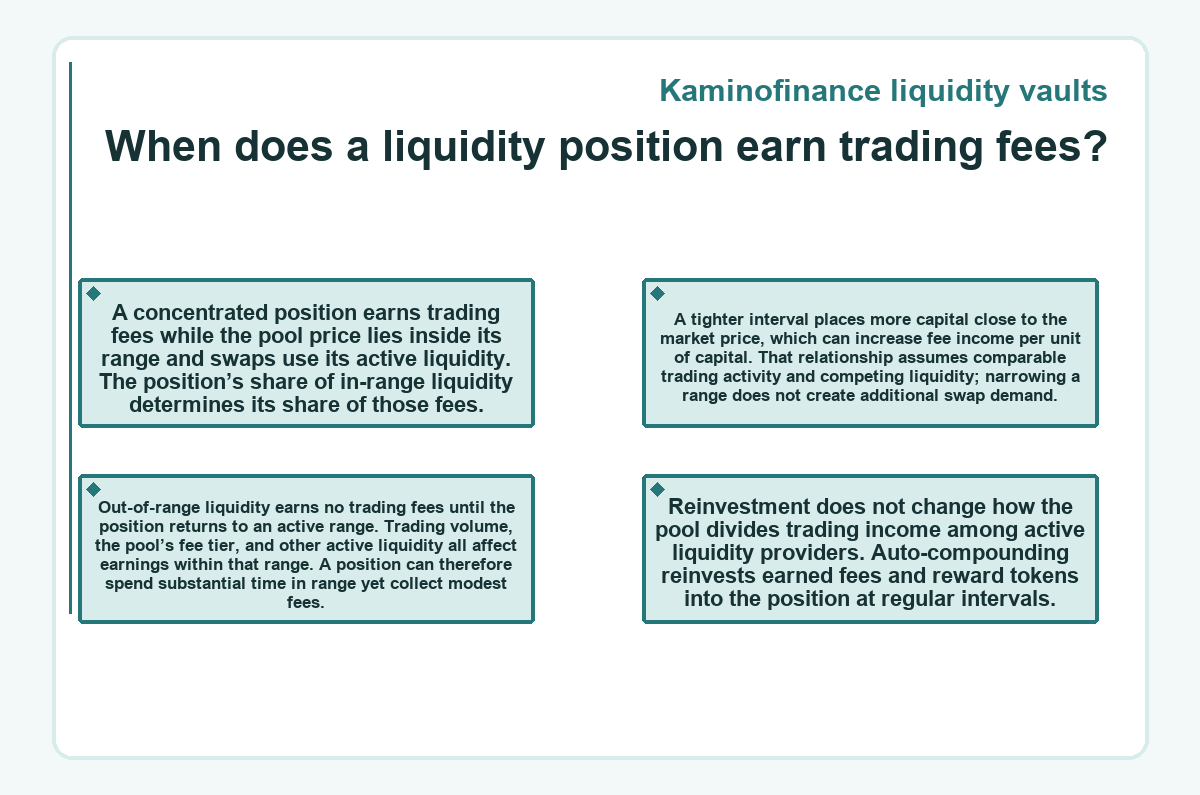
When does a liquidity position earn trading fees?
A concentrated position earns trading fees while the pool price lies inside its range and swaps use its active liquidity. The position’s share of in-range liquidity determines its share of those fees. A tighter interval places more capital close to the market price, which can increase fee income per unit of capital. That relationship assumes comparable trading activity and competing liquidity; narrowing a range does not create additional swap demand.
Out-of-range liquidity earns no trading fees until the position returns to an active range. Trading volume, the pool’s fee tier, and other active liquidity all affect earnings within that range. A position can therefore spend substantial time in range yet collect modest fees. Reinvestment does not change how the pool divides trading income among active liquidity providers.
Auto-compounding reinvests earned fees and reward tokens into the position at regular intervals.
How does automated rebalancing change the position?
Rebalancing closes an existing concentrated liquidity position and opens a new range centered around the market price. Automated bots rebalance liquidity positions when the market price leaves their configured ranges. The operation can require swaps to obtain the asset proportions that the new range needs. Those conversions can incur slippage and decentralized exchange (DEX) charges. The new placement restores fee eligibility at the prevailing price, while subsequent trading activity determines the income that it earns.
Price volatility and range width influence how often repositioning occurs. Smaller price moves can cross a tight range’s boundaries, creating more frequent conversion work. A wider range reduces that sensitivity while spreading capital across more prices. Rebalancing frequency alone does not determine total cost: the required conversion amount and execution conditions also matter. Automated execution removes manual repositioning work, while all depositors retain exposure to the pooled strategy’s adjustments.
Impermanent loss and performance relative to holding
Impermanent loss describes the value gap caused by changing pool-token quantities compared with holding the corresponding assets. As the relative price moves within the range, pool trades change the position’s token quantities. The LP ends up with less of the token that gained relative to its pair and more of the other token. For the same starting capital, concentrating liquidity increases how much of the position trades across a given relative-price movement within that range.
A rebalance restores an active range. It does not erase the position’s accumulated difference from holding the tokens.
Trading fees can offset this gap after accounting for the costs incurred in managing the position. Low trading activity and large relative-price moves weaken that balance. Compare both approaches over the same holding period and against the same starting exposure. Compounded fees already sit inside the vault position, so adding them again to its ending value would double-count income. Rebalancing costs also belong in the comparison, even when automation handles the operations.
A withdrawal fixes the LP-versus-holding difference for the redeemed shares over that holding period, even if the pair’s price later returns to its earlier level.
Token conversions at deposit and withdrawal
Single-token entry and exit involve conversion between the requested token and the pool’s required asset mix. At deposit, auto-swap converts the necessary portion into the other asset before deploying liquidity. A single-token withdrawal converts the redeemed position into the selected output token. These operations simplify token handling while introducing their own execution costs. The starting token and desired withdrawal token describe funding choices; the underlying pair determines the exposure throughout the deposit.
Entry conversion, later range adjustments, and exit conversion create separate cost events. Slippage and DEX fees depend on the swaps that each operation requires. A wider strategy may avoid some adjustments without removing the conversion needed for a chosen single-token exit. Lending vaults allocate a deposit token across lending reserves; liquidity vaults fund the two-asset pool position. Their different income sources make a lending rate an unsuitable substitute for expected LP fee income.
The withdrawal preview shows applicable swap costs before confirmation, allowing the selected output to be assessed against the current asset mix.
What does borrowing against a liquidity kToken change?
Borrowing against a liquidity kToken retains LP exposure while adding debt and the lending market’s liquidation conditions. Eligible liquidity kTokens can serve as collateral in Kamino Lend, with capacity subject to the selected market’s rules. A tighter or wider range still determines the liquidity strategy’s trading exposure. Collateral valuation and debt growth separately affect the loan’s health. Removing shares from collateral requires enough remaining collateral or repayment to satisfy the lending position’s withdrawal limits. Accruing interest can raise loan-to-value even while the LP earns trading fees.
Kaminofinance liquidity vaults: common questions
-
Does a pool fee tier state a liquidity vault’s annual return?
- A pool fee tier states the charge on each swap that uses the pool. A vault’s annual return reflects income and changes in position value over time. Trading activity, competing liquidity, time outside the range, and conversion costs affect the earnings associated with that tier.
-
Can trading fees accrue while the vault loses market value?
- Trading fees can accrue while the vault’s market value falls if swaps continue using its in-range liquidity. Fee income and asset valuation measure different changes. Falling pool-asset prices can outweigh the fees that the position earns, while impermanent loss separately measures performance against holding the corresponding tokens.
-
Why can a popular token pair produce little income in a particular vault?
- A popular pair can produce little vault income when trading activity concentrates outside its underlying pool. Total activity across venues does not establish the volume that generates fees for this position. Its active liquidity share and range status further determine how much of the relevant pool income reaches the vault.
-
Are single-token conversions free when the router charges no platform fee?
- A conversion routed through Kamino Swap can still incur DEX charges, Solana transaction fees, and slippage. The router charges no platform fee of its own. A single-token deposit or withdrawal can require a conversion between the selected token and the underlying pool’s asset mix.
-
Do equally wide ranges face the same next rebalance?
- Equally wide ranges can reach their boundaries after different amounts of price movement because placement relative to the current price also matters. The direction of the move determines which boundary approaches. The closer relevant boundary requires a smaller move before the position leaves its range.