 Kaminofinance
 borrowing creates collateral-backed debt within market liquidity and LTV limits
Updated
Kaminofinance borrowing provides liquidity against collateral on Solana when the selected market has lending capacity. It can suit borrowers who want liquidity without selling eligible collateral and can meet loan costs and repayment obligations. Check accepted collateral, available reserve liquidity, and loan-to-value (LTV) limits before borrowing. The resulting debt continues to accrue interest until repayment.
A quoted borrowing limit describes what the market permits at that moment. Price changes, accrued interest, and open Borrow Orders can change the usable margin. Plan how to repay the loan, including any fixed-rate maturity requirements.
Borrowing against JLP keeps the LP position open
The JLP Market supports borrowing against JLP, the Jupiter Liquidity Provider token, without unwinding the liquidity-provider position. Available reserve liquidity and collateral limits still determine how much the account can borrow. Keeping JLP as collateral preserves its market exposure while introducing a separate repayment obligation. A decline in its value can raise LTV, and borrowing costs can outweigh income from the retained position.
Accepted kTokens from Kamino liquidity vaults can also support borrowing, while their underlying concentrated-liquidity positions retain impermanent-loss exposure. These tokens represent different LP positions from JLP. The borrowing decision includes the risks of the specific collateral, alongside the loan itself. A repayment plan funded by the retained asset also exposes the exit to its future value.
Collateral, reserves, and the recorded obligation
Collateral must be deposited in the lending market that supplies the loan, and the selected debt reserve must have available assets for an immediate borrow. A market’s total deposits include assets that other borrowers already hold. That total does not establish the amount available for the next loan.
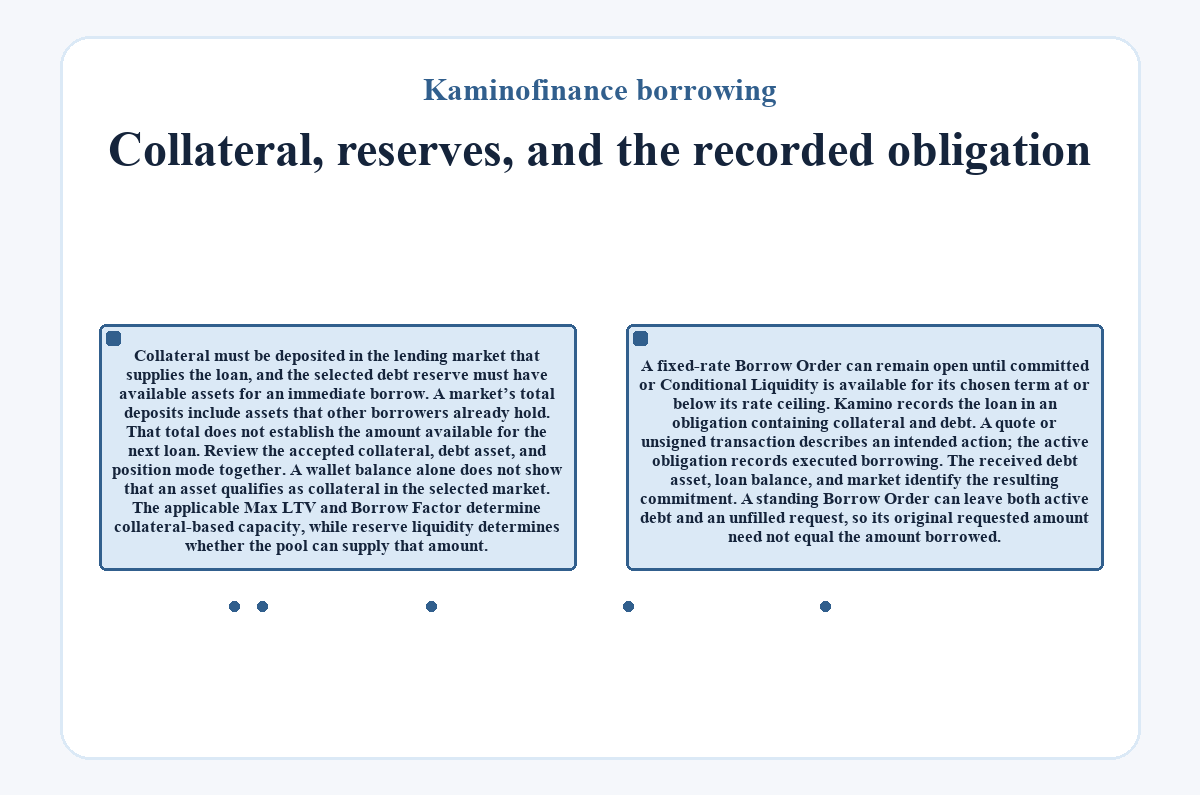
Review the accepted collateral, debt asset, and position mode together. A wallet balance alone does not show that an asset qualifies as collateral in the selected market. The applicable Max LTV and Borrow Factor determine collateral-based capacity, while reserve liquidity determines whether the pool can supply that amount. A fixed-rate Borrow Order can remain open until committed or Conditional Liquidity is available for its chosen term at or below its rate ceiling.
Kamino records the loan in an obligation containing collateral and debt. A quote or unsigned transaction describes an intended action; the active obligation records executed borrowing. The received debt asset, loan balance, and market identify the resulting commitment. A standing Borrow Order can leave both active debt and an unfilled request, so its original requested amount need not equal the amount borrowed.
How much capacity remains after collateral loses value?
Borrowing capacity falls when collateral value falls, while the existing debt remains outstanding. Current LTV measures debt relative to collateral, and the selected debt asset’s Borrow Factor risk-weights debt for borrowing limits and liquidation checks.
Opening limits and liquidation thresholds
Capacity for additional debt
For a single collateral and debt asset, borrowing capacity equals collateral value multiplied by Max LTV, divided by the debt asset’s Borrow Factor. A factor above 1 reduces the amount available against the same collateral. Existing debt consumes part of that capacity.
Eligibility for liquidation
Liquidation LTV sets a separate threshold above Max LTV. Borrow Factors also apply to liquidation checks, so debt with a factor above 1 can reach that threshold at a lower unadjusted debt value. A position can lose permission to add debt before it becomes eligible for liquidation. Price movements and accrued interest can push it through both boundaries without another borrowing action.
A collateral decline changes the borrowing margin
All inputs in this comparison are hypothetical. Assume collateral worth $12,486, no existing debt, a Borrow Factor of 1, Max LTV of 72%, and Liquidation LTV of 79%. Assume the reserve can fund planned debt worth $7,236.
The opening ceiling is $12,486 multiplied by 72%, or $8,989.92. Borrowing debt worth $7,236 fits that ceiling and produces approximately 57.95% LTV before subsequent interest. The obligation then contains that debt; unused borrowing capacity is not another wallet balance.
Change only collateral value to $9,364.50, holding the debt valuation and settings constant. The same $7,236 debt now produces approximately 77.27% LTV. That exceeds the assumed opening limit of 72% but remains below the assumed liquidation threshold of 79%.
The position has no capacity for additional debt under these inputs. It has not yet crossed the liquidation boundary. Repayment or additional eligible collateral would reduce LTV, while accrued interest would increase it. The capacity rule stays unchanged; the collateral valuation changes the outcome.
Variable interest and term-specific loan costs
Outstanding debt accrues interest, and the rate type determines whether reserve utilization can change the borrowing rate during the position’s lifetime. The repayment date also affects total cost.
Variable-rate costs
Higher reserve utilization pushes variable borrowing rates upward. An opening quote cannot establish the total interest cost for an unknown holding period. A supply annual percentage yield (APY) describes income to suppliers, rather than the rate charged to borrowers. Comparing those figures without their roles can overstate the income available to cover debt costs.
Fixed-rate costs
A fixed-rate loan keeps its borrowing rate through the agreed term. Early repayment may carry an Early Repay Penalty during the first term only. After rollover into a subsequent term, that penalty no longer applies. The position’s term and repayment timing therefore affect the cost of closing it.
Liquidation adds collateral losses beyond ordinary borrowing interest. Repayment using collateral can also involve conversion costs. These expenses arise from different actions, so the borrowing rate alone does not describe every possible cost of the position.
Fixed-rate maturity can require collateral repayment
Auto-rollover starts enabled on new fixed-rate positions, but an enabled setting cannot ensure that the reserve will have liquidity when the term ends. Repayment becomes due at the end date if the loan does not roll over.
With auto-rollover enabled, the protocol attempts another term at the same rate during the configured rollover window. Available liquidity and the absence of queued withdrawal tickets govern that extension. If fixed-rate rollover fails, a configured variable-rate fallback may move the debt into the same asset’s variable reserve in the same lending market. The fallback changes the rate basis.
If neither rollover path succeeds and the borrower leaves the loan open, Auto-repay begins at the end date. It gradually uses collateral to repay debt over a market-configured window. Its charges rise across that window. Closing before maturity avoids Auto-repay, although first-term early repayment conditions may still affect the exit cost.
Borrow Orders reserve capacity before a fill
Open Borrow Orders count toward post-fill LTV, which includes active debt plus all outstanding order amounts relative to collateral value. The protocol evaluates the position as though every open order fills. Under the documented Borrow Orders rule, post-fill LTV cannot exceed Max LTV minus 5 percentage points. This constraint also limits collateral withdrawals while orders remain open. Current LTV reflects filled borrowing, so a low current figure can coexist with little capacity for another order. Orders may fill incrementally as liquidity becomes available.
Each filled portion reaches the wallet and starts accruing interest; the unfilled remainder carries no interest. Fixed-rate orders also specify a rate ceiling and term. Lending vaults can provide Conditional Liquidity that moves into the matching fixed-rate reserve when an eligible order fills. A standing request therefore establishes potential borrowing, while fills establish actual debt.
An unfilled order can signal a collateral constraint
An unfilled order can reflect absent reserve supply or a post-fill LTV constraint, even when the account shows little active debt. These conditions require different responses.
A collateral decline does not automatically shrink or cancel open orders. Their original amounts remain in the post-fill calculation. The protocol refuses a fill that would breach the capacity limit, and the order can become fillable again if collateral value recovers.
Reducing the unfilled amount or adding eligible collateral can restore collateral-based headroom. Neither action supplies missing reserve liquidity. An older order also gains no priority from its submission time; fill ordering does not provide a first-in, first-out borrowing queue.
Spare liquidity in another market does not fund this market’s loan. Market isolation keeps collateral and liquidity separate. Repeated submission cannot remove those boundaries, so the relevant constraint remains the selected obligation’s capacity and its reserve’s available supply.
Repaying debt and releasing collateral
Repayment reduces outstanding debt, while collateral withdrawal removes assets that support the position. Full repayment must cover accrued interest as well as principal. Zero debt and the return of collateral describe different parts of an exit. Open orders also matter after repayment because later fills can create new debt. Closing an unwanted unfilled request removes that potential commitment. The remaining active obligation shows any debt still owed, while the wallet balance shows whether the intended collateral withdrawal has returned assets.
Repay with Collateral uses Kamino Swap to convert part of the deposited collateral into the debt asset. Kamino Swap restricts interface access for users in the United States, the United Kingdom, and other restricted jurisdictions. The protocol repays the loan within the same atomic transaction. Kamino Swap charges no platform fee, while Solana transaction fees and costs embedded in the underlying route still apply. Price impact and slippage can affect how much collateral the conversion consumes.
Collateral withdrawals remain subject to account-health requirements and available reserve liquidity. Repaying debt improves the collateral ratio, but it does not establish immediate access to assets that other borrowers still hold.
Market modes change the exposure behind the loan
Cross Mode evaluates multiple collateral and debt assets together, so a decline in one collateral can affect the whole position. Configured elevation groups, or eMode, allow higher LTV for designated correlated pairs. Those permissions apply to the selected assets and market. Multiply uses the lending infrastructure to automate leveraged positions, adding exposure beyond a simple liquidity loan. A direct swap sells the selected amount for liquidity and may fit better when retaining that exposure does not justify loan costs and repayment obligations. Borrowing retains collateral exposure and creates a continuing debt obligation.
Kaminofinance borrowing: what people ask
Does a rising debt-token price reduce the remaining borrowing margin?
A rise in the debt asset’s value can increase LTV even when the token amount owed stays unchanged. Position health compares debt and collateral valuations, so unchanged balances do not imply unchanged capacity. The effect follows the debt price relative to the collateral price. Interest adds another source of debt growth, which can compound an adverse relative price move.
Are SOL LST Multiply loans sensitive to SOL’s dollar price?
Within a supported SOL liquid staking token (LST) Multiply position, SOL’s dollar price alone does not change collateral value relative to SOL debt. The stake-rate oracle prices LST collateral using its staking exchange rate. An underlying staking protocol failure can affect that rate. Sustained borrowing costs above staking yield can also deteriorate position health.
How many Borrow Orders can one Kamino obligation hold for the same debt asset?
One obligation can hold one open Borrow Order per debt asset. The existing order supports adjustments to its unfilled amount and expiry, subject to capacity constraints. An obligation may have orders for different debt assets, but the post-fill calculation includes all open amounts. Creating another request for the same asset does not provide a separate capacity allowance.
When does an expiring Borrow Order stop creating new debt?
Expiry removes the unfilled portion of a Borrow Order, ending that order’s ability to create further borrowing. Portions that filled before expiry remain active loans and continue accruing interest. The expiry date therefore governs the standing request, rather than the repayment date for existing debt. Expired orders carry no expiry fee or penalty.
Do permissioned lending markets require an allowlisted wallet before borrowing?
A permissioned lending market requires authorization for a borrowing action when its configuration gates that operation. The kperm program enforces per-user permissions on-chain. Connecting a wallet does not itself establish that permission, and an allowlist entry does not replace collateral or liquidity requirements. This access condition belongs to the permissioned market; ordinary borrowing mechanics do not make every market permissioned.
Can a lending vault’s Insurance Pool protect a separate borrowing position?
An Insurance Pool backs losses for depositors in its particular lending vault. The curator locks capital that can compensate affected depositors after the vault incurs bad debt and socializes losses. That mechanism does not change a separate borrower’s LTV, debt balance, or repayment obligations. A borrowing position still faces liquidation under its own market’s rules, regardless of a lending vault’s backstop.