 Kaminofinance
 combines managed lending with borrowing and liquidity tools on Solana
Updated
Kaminofinance routes single-token lending vault deposits across Kamino reserves within a Solana suite for borrowing, liquidity management, leveraged strategies, and swaps. Curators set each lending vault’s allocations, while share tokens represent a depositor’s claim on its assets. Borrowing uses collateral and reserve liquidity. Liquidity vaults earn trading fees, Multiply adds leveraged exposure, and Swap handles token conversions.
The source of returns changes with the product. Lending depends on borrower interest, concentrated liquidity depends on trading activity, and leveraged positions add financing costs. Those differences shape fees, withdrawal availability, and exposure to losses.
Where do lending vault deposits earn interest?
Lending vault deposits earn interest across the Kamino lending reserves that the curator selects for that vault. Lending vaults support assets including USDC, SOL, and JLP; each vault accepts its configured token. A reserve holds liquidity for a particular lending asset. Curators distribute pooled deposits across reserves using allocation weights and exposure limits. Depositors therefore share the portfolio’s combined lending exposure, including changes that the curator makes after a deposit.
Vault shares express ownership through the amount of underlying assets attributable to each share. Interest accrual increases assets per share without adding periodic interest payments to the wallet. Holding the same share count can therefore represent a growing claim. Fees and lending losses also affect the assets behind those shares.
A direct supplier chooses a reserve and earns that pool’s interest without delegating allocations to a curator. Variable-rate supply returns reflect borrowing demand and reserve utilization.
Withdrawals depend on liquid capital. A lending vault maintains an unallocated buffer, and larger withdrawals require liquidity from its reserves. High utilization can delay access until borrowers repay. The value of a share and the availability of tokens for redemption answer different questions.
Lending vault settings determine exposure and access
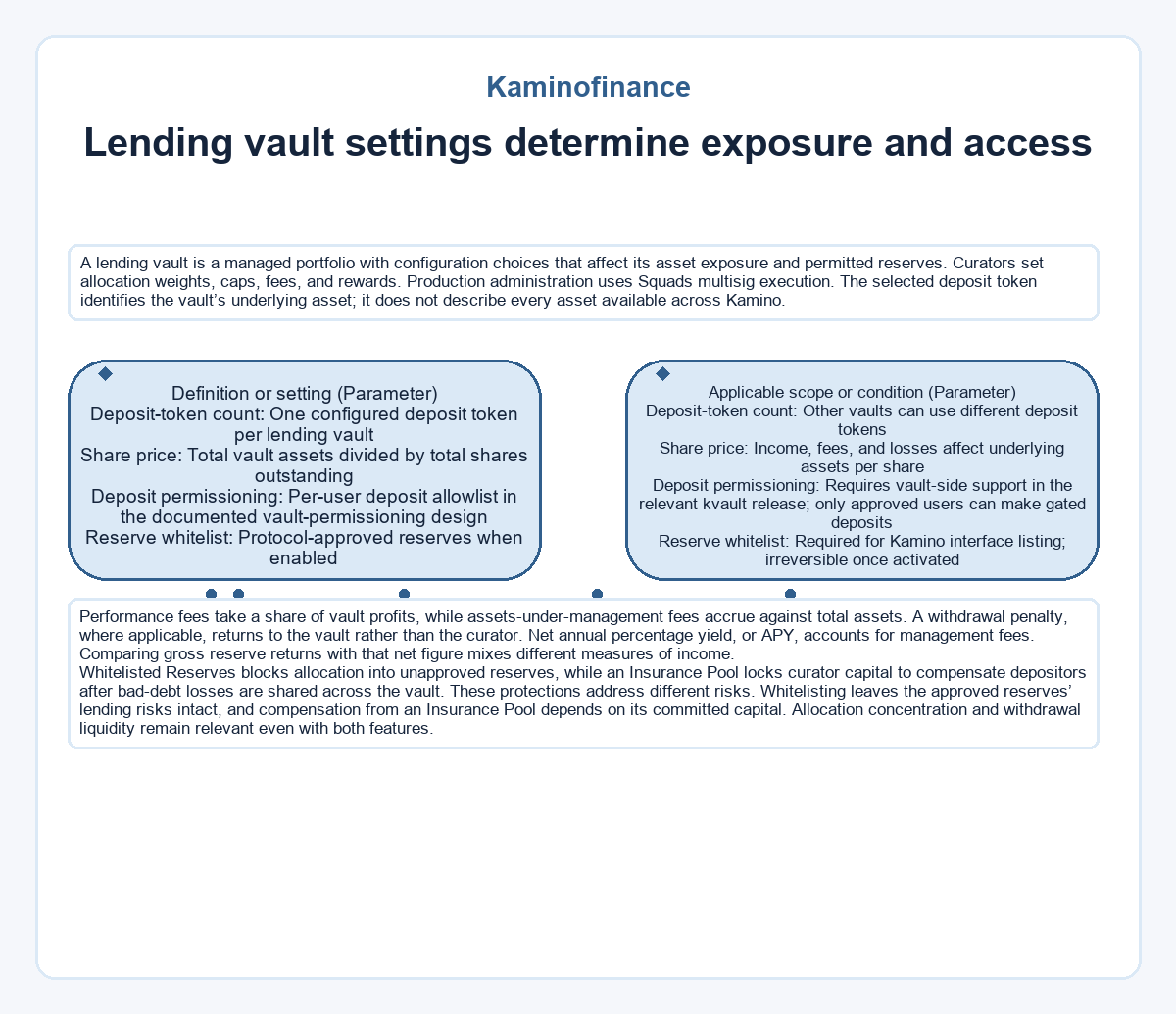
A lending vault is a managed portfolio with configuration choices that affect its asset exposure and permitted reserves. Curators set allocation weights, caps, fees, and rewards. Production administration uses Squads multisig execution. The selected deposit token identifies the vault’s underlying asset; it does not describe every asset available across Kamino.
| Parameter | Definition or setting | Applicable scope or condition |
|---|---|---|
| Deposit-token count | One configured deposit token per lending vault | Other vaults can use different deposit tokens |
| Share price | Total vault assets divided by total shares outstanding | Income, fees, and losses affect underlying assets per share |
| Deposit permissioning | Per-user deposit allowlist in the documented vault-permissioning design | Requires vault-side support in the relevant kvault release; only approved users can make gated deposits |
| Reserve whitelist | Protocol-approved reserves when enabled | Required for Kamino interface listing; irreversible once activated |
Lending vault settings determine exposure and access
- Definition or setting (Parameter) Deposit-token count: One configured deposit token per lending vault Share price: Total vault assets divided by total shares outstanding Deposit permissioning: Per-user deposit allowlist in the documented vault-permissioning design Reserve whitelist: Protocol-approved reserves when enabled
- Applicable scope or condition (Parameter) Deposit-token count: Other vaults can use different deposit tokens Share price: Income, fees, and losses affect underlying assets per share Deposit permissioning: Requires vault-side support in the relevant kvault release; only approved users can make gated deposits Reserve whitelist: Required for Kamino interface listing; irreversible once activated
Performance fees take a share of vault profits, while assets-under-management fees accrue against total assets. A withdrawal penalty, where applicable, returns to the vault rather than the curator. Net annual percentage yield, or APY, accounts for management fees. Comparing gross reserve returns with that net figure mixes different measures of income.
Whitelisted Reserves blocks allocation into unapproved reserves, while an Insurance Pool locks curator capital to compensate depositors after bad-debt losses are shared across the vault. These protections address different risks. Whitelisting leaves the approved reserves’ lending risks intact, and compensation from an Insurance Pool depends on its committed capital. Allocation concentration and withdrawal liquidity remain relevant even with both features.
Collateralized borrowing draws from shared reserves
Kamino Borrow provides overcollateralized loans from shared lending pools, with borrowing capacity tied to collateral value and market parameters. The borrower supplies eligible collateral, and the reserve supplies the debt asset. Available capacity requires both adequate collateral and accessible liquidity in the selected reserve.
Loan-to-value, or LTV, describes debt relative to collateral value. Maximum LTV governs opening or increasing a borrow. Liquidation LTV identifies the threshold at which a position becomes eligible for liquidation. Borrow factors can reduce capacity for riskier debt assets, so one collateral valuation does not imply identical borrowing capacity across every asset.
Outstanding debt accrues interest. Variable rates respond to reserve utilization, the proportion of supplied liquidity that borrowers have drawn. Accumulated interest can weaken position health even when collateral prices stay unchanged. Collateral pricing and the debt asset’s risk treatment also matter. A position’s borrowing ceiling and liquidation boundary therefore require the applicable market settings.
Borrow Orders provide standing requests that fill when matching liquidity becomes available. They can fill partially, with interest starting on each filled portion. Open order amounts also constrain borrowing capacity and collateral withdrawals. Repay with Collateral offers a separate function: it converts deposited collateral into the debt asset and repays debt within an atomic transaction.
Fixed-rate borrowing has a term and maturity obligations
Fixed Rates locks a borrowing rate for a defined term within a reserve that offers the selected terms. Each rate-and-duration combination has independent liquidity. Borrow Orders match requests against committed or conditional liquidity, up to the requested rate ceiling. Conditional liquidity lets vault capital earn in variable-rate reserves until a fixed-rate match draws it into the target reserve. Direct lenders commit capital to their selected fixed-rate reserve immediately. Their mid-term withdrawals require queued requests and depend on capital returning.
New loans enable auto-rollover by default. Fixed-rate renewal requires available liquidity and no queued withdrawal tickets in the reserve. A variable-rate fallback requires the relevant market configuration. If neither path succeeds and debt remains at maturity, Auto-repay gradually uses collateral to repay it, subject to fees.
Liquidity vaults automate concentrated market making
Liquidity vaults manage positions that supply assets within price ranges on decentralized exchanges. Their income comes from trading fees and applicable rewards. Kamino automates token-ratio conversion, fee reinvestment, and range adjustment. Single-token entry can still create exposure to both underlying pool assets because the strategy swaps the portion needed for liquidity provision.
A position earns trading fees while the market price lies within its active range. Moving outside that range stops fee income until the position becomes active again. Rebalancing changes the range and can incur conversion costs. Liquidity vault kTokens represent proportional ownership of the liquidity position. Impermanent loss measures its performance difference against holding the underlying assets, so compounding fees alone does not establish a superior return.
Multiply adds leverage to yield strategies and tokenized stocks
Multiply constructs leveraged positions through Kamino Borrow using yield-bearing assets or tokenized stocks. A flash loan supplies temporary financing, while collateral and ongoing debt form the lasting position. Opening, adjusting, and closing use atomic transactions; failure to repay the flash loan reverses the transaction. Financing costs reduce net returns from yield-bearing collateral. xStocks strategies depend on equity price appreciation, with no yield component to offset borrowing costs. Leverage magnifies gains and losses. Position health depends on the strategy’s collateral pricing and liquidation parameters. Elevation Mode (eMode) increases permitted LTV only for designated correlated asset pairs.
Institutional Yield introduces off-chain lending exposure
Institutional Yield connects stablecoin vault deposits to collateralized lending operations through a special-purpose vehicle, or SPV. Each vault has its own borrowers, collateral, and lending operation. Commodity Yield uses physical commodities or escrowed cash. Digital Assets Yield uses digital-asset collateral held at qualified custodians. These arrangements introduce counterparty and custody exposure beyond on-chain lending reserves.
Interest from the underlying loans returns through the structure to vault depositors. Withdrawals within the available buffer settle immediately. Larger withdrawals enter a first-in, first-out queue and depend on principal returning as underlying loans mature. Monthly independent attestations and loan-level reporting provide information about the portfolios; they do not supply withdrawal liquidity.
Regulatory supervision applies to the lending operation, without providing deposit insurance or a regulatory guarantee to vault depositors. Institutional Yield depositors are unsecured creditors of the SPV under the Loan Agreement. Collateral securing a borrower’s loan therefore does not give the depositor a secured claim against the SPV. Access to Institutional Yield also follows its jurisdiction restrictions and Loan Agreement.
The December 2025 expansion announcement outlined Private Credit vaults, custodied-asset borrowing using Chainlink attestations and an Anchorage Digital integration, and an oracle-priced exchange for real-world assets named the RWA DEX. It also proposed Borrow Intents for lenders to fill borrower-selected terms. The custody design called for assets to remain with a qualified custodian while Chainlink attested collateral values. The proposed exchange would position liquidity around oracle prices for tokenized assets.
How do Swap and BuildKit work with Kamino’s products?
Kamino Swap handles standalone trades and conversions for Multiply and Repay with Collateral; BuildKit provides tools for integrating Kamino into applications. Swap’s routing layer queries multiple engines and compares output quotes. Active Simulation can test the proposed transaction against on-chain conditions before execution. A simulation provides an execution estimate, while on-chain execution determines the actual outcome. Swap charges no platform fee, although Solana transaction fees and costs embedded in the underlying route remain. Price impact reflects the trade’s effect on available liquidity. Slippage reflects changes between the quote and execution. The configured tolerance limits acceptable execution movement; neither an attractive quote nor a simulation removes those constraints.
Limit Orders hold input tokens in on-chain escrow and fill at the specified rate or better when execution is available. They can fill partially, and filled outputs require a claim. Swap and Limit Orders restrict interface access in the United States, the United Kingdom, and other restricted jurisdictions. That restriction concerns these interfaces, rather than establishing one access rule for every Kamino function.
BuildKit exposes the protocol to applications through a REST API, a TypeScript SDK, and Rust tooling. The API provides data, analytics, and unsigned transactions; the SDK supports on-chain reads and transaction building. Curator tools also support creating and operating vaults and markets. Signing and successful on-chain execution remain necessary for the operation.
Things people ask about Kaminofinance
Is KMNO interchangeable with a lending vault share?
KMNO is Kamino’s native token, while a lending vault share represents a claim on a particular vault’s assets. Holding KMNO does not by itself establish ownership of those vault assets. Share tokens derive their value from the portfolio that backs them.
Does cancelling a Borrow Order erase a loan that has already filled?
Cancelling a Borrow Order removes only its unfilled portion. Filled portions remain active borrow positions and continue accruing interest. Order cancellation carries no cancellation fee, and repayment remains a separate obligation for the borrowed amount. Expiry follows the same distinction: it removes the unfilled remainder without extinguishing debt from earlier fills.
When does a fixed-rate loan incur an early repayment penalty?
An Early Repay Penalty may apply when a fixed-rate loan is repaid during its first term. It compensates lenders for capital that they committed for the agreed duration, using a minimum-interest calculation. After the loan rolls into a subsequent term, this penalty no longer applies. A borrower can close before the end date without waiting for maturity.
Which earnings does the supply APY exclude?
The base supply annual percentage yield excludes KMNO emissions, external token incentives, and farm rewards. It reflects borrower interest passed through to lenders. When a reserve has incentive programs, their rewards appear separately from that base return.
Can a lending vault share be transferred to another wallet?
Lending vault shares are standard fungible tokens that can move between wallets. Their use as collateral elsewhere depends on whether the receiving protocol accepts that exact share token. A transferred share continues to represent the same vault portfolio. Moving it does not change the curator’s allocation strategy or make the vault’s underlying liquidity immediately available.